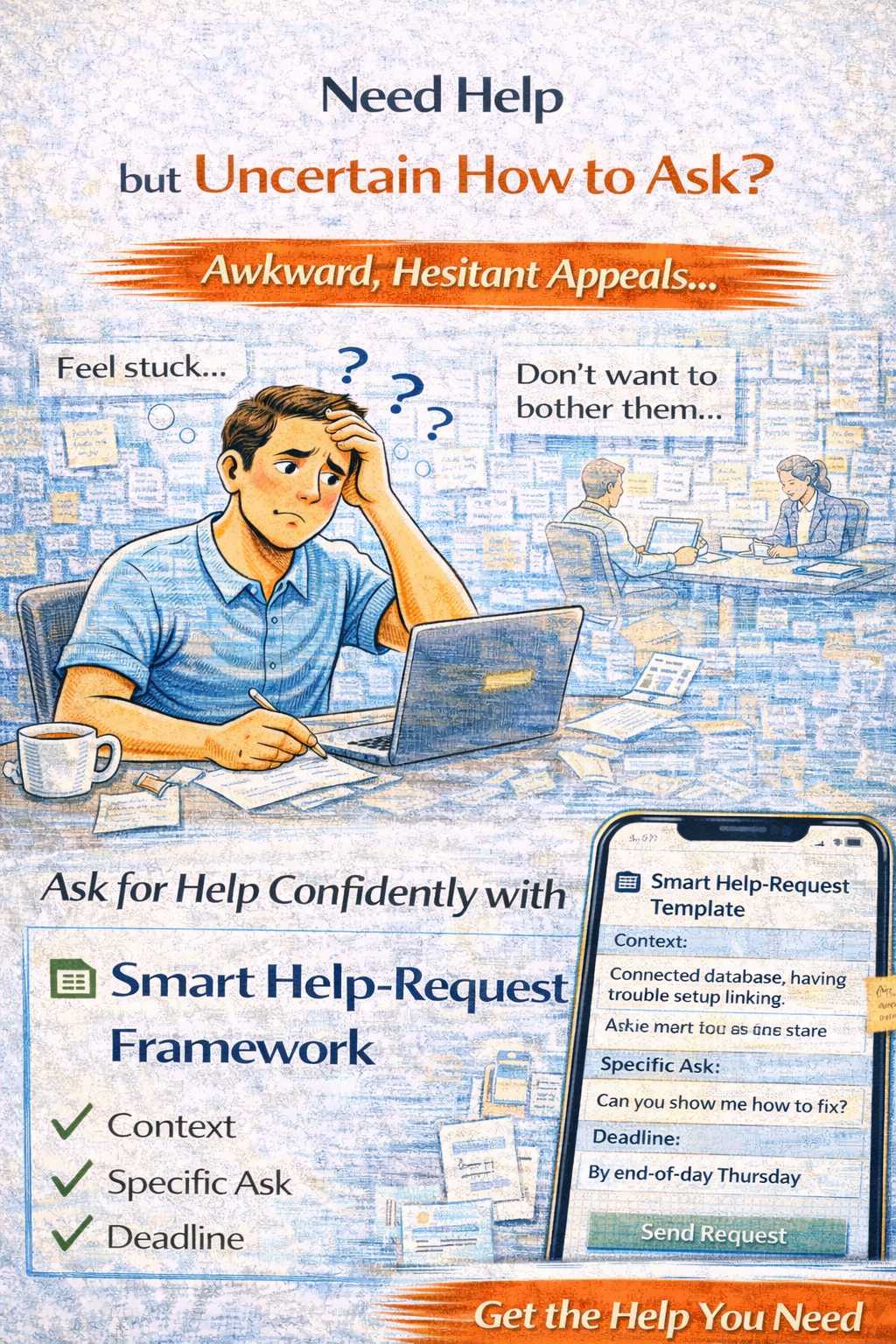
Smart Help-Request Framework | Ask for Help Clearly, Get Better Answers
Smart Help-Request Framework | Ask for Help Clearly, Get Better Answers
100% Satisfaction Guaranteed
24/7 Customer Support
Trusted by Thousands
Couldn't load pickup availability
Description
Description
"I need help but I don't want to sound stupid." "I don't want to interrupt them." "What if they think I should already know this?"
If you've ever hesitated to ask for help at work because you weren't sure how to ask... or sent a vague request and got an unhelpful response... or felt anxious before and after asking... this framework is for you.
The Problem with Asking for Help
Many junior employees hesitate to ask for help—not because they don't need it, but because they're unsure how to ask without sounding unprepared, interrupting others, or appearing incompetent.
Without structure, people:
- Delay asking for help (struggle alone for hours when 5 minutes of help would solve it)
- Ask too vaguely ("Can you help me with this?" gets vague answers)
- Over-explain or under-explain (ramble nervously or provide no context)
- Feel anxious before and after asking ("Did I sound dumb? Did I bother them?")
- Get unhelpful responses because the request wasn't clear
This slows learning and increases stress.
The Solution: A Repeatable Formula for Clear Requests
The Smart Help-Request Framework provides a simple structure that turns vague or anxious requests into clear, respectful, and actionable communication.
Instead of winging it, you use a repeatable formula: Context, Specific Ask, Deadline, Format. This makes help requests easier to respond to—and easier to send.
What's Included:
1. Help Request Builder
- Prepare clear requests before sending them
- Fill in prompts to structure your request
- Practice before hitting send
- Build confidence through preparation
- Reduce anxiety by having a plan
2. Context & Specificity Prompts
- Ensure clarity without over-explaining
- Context: What are you working on? What have you tried?
- Specific Ask: What exactly do you need help with?
- Avoid vague requests that get vague answers
- Provide enough context without rambling
3. Deadline & Format Selection
- Respect others' time while getting what you need
- Deadline: When do you need this by?
- Format: Quick answer, 15-min call, written explanation?
- Make it easy for them to help you
- Show respect for their schedule
4. Reflection Section
- Build confidence and skill over time
- After getting help: What worked? What would I do differently?
- Track successful request patterns
- Improve communication skills systematically
- Reduce anxiety through learning
Perfect For:
Junior employees, Early-career professionals, New hires, Anyone who feels anxious asking for help at work, People who want to improve professional communication
How It Transforms Help Requests:
Without the framework:
Vague request: "Hey, can you help me with this report?" Response: "Sure, what do you need?" You: "Um, I'm not sure how to format it." Them: "Check the template." You: Still confused, too anxious to follow up
With the framework:
Prepare request: Context: "I'm working on the Q4 sales report. I've reviewed the template but I'm unclear on how to format the regional breakdown section." Specific Ask: "Could you show me an example of how you formatted the regional breakdown in last quarter's report?" Deadline: "I need to submit this by Friday, so anytime this week works." Format: "A quick 10-minute call or a link to an example would be perfect."
Send request: Clear, specific, respectful. Response: "Sure! Here's last quarter's report—see page 5 for the regional breakdown. Let me know if you have questions." You: Problem solved in 5 minutes.
Reflection: What worked: Being specific about what I needed. Next time: Always include what I've already tried.
The difference? Clear requests get better answers.
Why This Works:
Reduces anxiety around asking for help, Improves response quality, Speeds up learning and problem-solving, Builds professional communication skills, Easy to use in real work situations, Clear requests lead to better support
How to Use:
Step 1: Fill out one row before asking for help (3-5 minutes)
Step 2: Use the prompts to structure your request
Step 3: Send or say your request confidently
Step 4: Reflect briefly afterward
Step 5: Build skill and confidence over time
Time required: 3-5 minutes per request
What Makes This Different:
Unlike generic communication advice, this framework is designed specifically for junior employees who feel anxious asking for help. It provides a repeatable structure that removes the guesswork and builds confidence through practice.
Ask for help clearly. Get better answers. Reduce anxiety.
Digital download delivered instantly. Fully editable Google Sheets. Build professional communication skills. No shipping required.